
The Utah Internet Crimes Against Children (ICAC) Task Force is a nationally recognized, multi-jurisdictional program with a mission to protect children from online exploitation by investigating and prosecuting internet crimes against minors. The task force is funded by a grant from the Office of Juvenile Justice and Delinquency Prevention and administered through the OAG.
With over 200 dedicated task force members and 93 affiliates across local, state, and federal levels, Utah ICAC is a vital force in safeguarding our communities. The Utah Attorney General ICAC Task Force was created in 2000 and is one of 61 ICAC task forces in the country.
We work in close partnership with the National Center for Missing and Exploitation Children (NCMEC), law enforcement agencies, and prosecutors to identify offenders, rescue victims, and bring justice to those who exploit children online.
From proactive undercover operations to digital forensic investigations, our team is on the front lines of combating child sexual abuse material, online enticement, and trafficking.
Beyond enforcement, we are committed to prevention and education. Through community outreach, school presentations, and online safety resources for parents, educators, and youth, we empower Utahns to navigate the digital world safely. Our team also engages in national operations like Operation Safe Online Summer to protect the most vulnerable among us.
Every investigation, every arrest, and every outreach effort is driven by one goal: to ensure that every child in Utah can grow up safe—both online and in the real world.
Navigating the digital world can be challenging for parents. The office has gathered trusted resources to help you protect your children online—offering tools, guidance, and support every step of the way.
The internet opens up a world of opportunities, but it’s important to stay alert and informed. Explore tips and tools from the office to help you stay safe online.
As educators, you’re on the front lines of helping students navigate the digital world safely. The office is here to support you with the tools and resources you need to teach internet safety with confidence and impact.
The Utah Internet Crimes Against Children (ICAC) Task Force—led by the office—partners with local law enforcement, the National Center for Missing and Exploited Children (NCMEC), and other state and federal agencies to investigate and prevent online threats, ensuring a safer digital space for our children.
REPORT AN INCIDENT: (801)281-1211
The office is committed to providing access to high-quality, effective resources to help you stay informed about the evolving risks children face online. These materials are intended to support your efforts in protecting youth across Utah and beyond.
Please note: The views and opinions expressed within these resources do not necessarily reflect the official positions of the Utah ICAC Task Force, the Office of Juvenile Justice and Delinquency Prevention (OJJDP), or the U.S. Department of Justice.
Internet Safety & Education
Support for Victims
Discover how the ICAC Task Force brings together law enforcement agencies from across the state. Click the icon to learn more.
Educate your child about the dangers online. Follow up on what your child is doing on the internet. Never assume that someone your child has met online is who he or she claims to be.
Never post pictures of yourself on the internet or e-mail them to people you don’t personally know.
You should immediately contact your local police department, sheriff’s office, or the Division of Child and Family Services. In Weber County, call (801)629-5800 or CPS Intake at (801)395-5911.
You can report online child sexual exploitation by calling your local police department or sheriff’s department. You may also call the Utah ICAC Tip Line at (801)281-1211 or email utahicac@agutah.gov.
The ICAC Task Force investigates online crimes that target minors, with a focus on identifying and apprehending individuals who sexually exploit minors through online grooming, solicitation, and the creation, distribution or possession of child sexual abuse material.
Everyone.
The Utah ICAC Task Force delivers measurable, life-saving results in the fight against online child exploitation. Through coordinated investigations, cutting-edge digital forensics, and community outreach, the task force has become a model nationwide for protecting children.
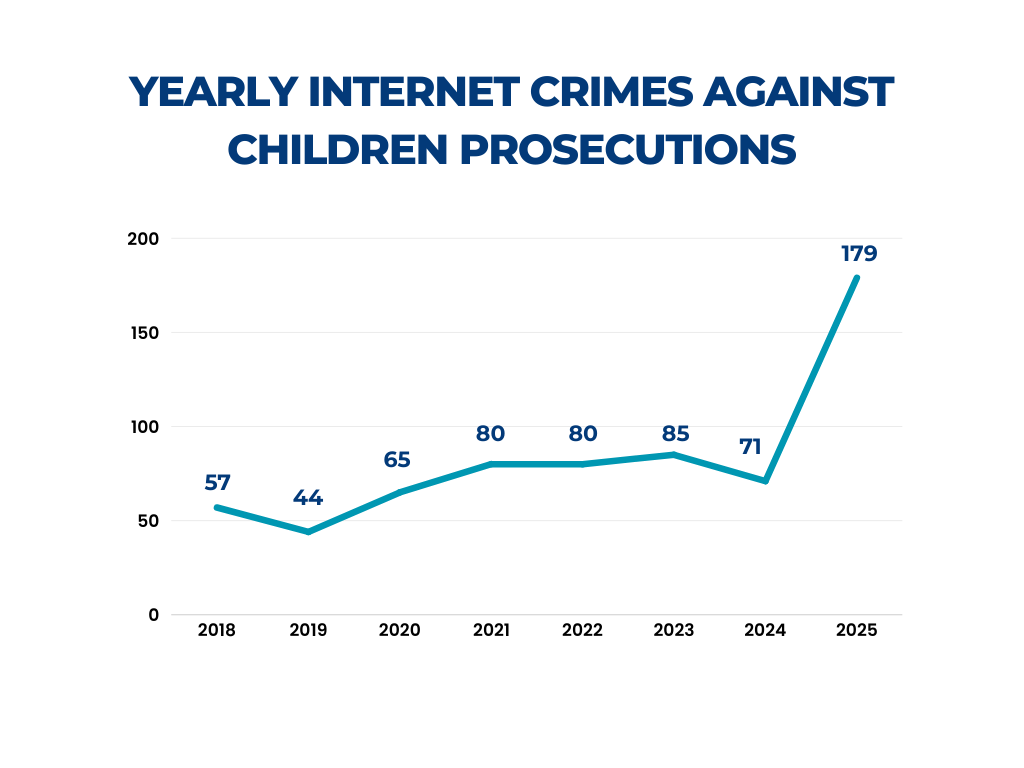
During 2025, the Utah ICAC Task Force submitted more than double the number of cases for prosecution compared to 2024, underscoring the office’s commitment to protecting children.
In 2025 alone, Utah ICAC opened 179 new cases. This was made possible due to the diligent efforts of our investigators and prosecutors. ICAC prosecutors attended a total of 764 hearings this year.
During one operation alone—Operation Hive Strike—Utah ICAC Task Force arrested 15 people who face felony and misdemeanor charges that include, but are not limited to, sexual exploitation of a minor, dealing in harmful materials to a minor, enticing a minor, aggravated sexual exploitation of a minor, aggravated sexual abuse of a child, sodomy on a child, possession of a controlled substance, and possession of a stolen firearm. In a landmark case, Utah ICAC made the state’s first known arrest involving cryptocurrency used to purchase child sexual abuse material. The task force stays ahead of trends to better protect the people of Utah.
The task force’s work extends beyond enforcement. ICAC investigators and trainers regularly educate parents, students, and educators about online safety, sextortion, and digital grooming. In 2025, Utah ICAC conducted 25 trainings and presentations.
Utah ICAC collaborates with local, state, and federal partners, including the SECURE Strike Force. These partnerships have enabled high-impact operations like Operation Crimson Desert, which targeted child exploitation, human trafficking, and narcotics interdiction in Moab.
The office is committed to providing access to high-quality, effective resources to help you stay informed about the evolving risks children face online. These materials are intended to support your efforts in protecting youth across Utah and beyond.
Please note: The views and opinions expressed within these resources do not necessarily reflect the official positions of the Utah ICAC Task Force, the Office of Juvenile Justice and Delinquency Prevention (OJJDP), or the U.S. Department of Justice.
Internet Safety & Education
Support for Victims
Talk Early, Talk Often. Open communication is the foundation of online safety. Encourage your children to come to you with questions or concerns. Let them know they won’t be punished for being honest about something that made them uncomfortable online.
Know the Apps. Stay informed about the apps your children use. Learn how they work, what privacy settings are available, and how predators might exploit them. Understanding the digital landscape and using parental controls helps you guide your child through it safely.
Set Boundaries. Teach your children not to share personal information—like their location, school, or photos—online. Use parental controls and ensure all accounts are set to private. Strong passwords and updated security software are essential.
Watch for Warning Signs. Be alert to behavioral changes that may signal online exploitation and grooming. These include secrecy about online activity, sudden withdrawal from family, or receiving messages from unknown numbers. Kids may also use apps that hide content from parents.
Address Sextortion and Cyberbullying Head-On. Utah ICAC has seen a rise in sextortion cases. Remind children that it’s never their fault if they’re targeted. Create a supportive environment where they feel safe reporting abuse. Also, talk about cyberbullying—whether they’re a target, bystander, or participant—and how to respond safely.
Talk to a Trusted Adult. If something online makes you feel weird, scared, or confused—tell someone you trust, like a parent, teacher, school resource officer, or school counselor. You’re never in trouble for asking for help.
Think Before You Share. Don’t post your full name, address, school, or photos that show where you are. Once something’s online, you can’t take it back, even if you delete it.
Use Privacy Settings. Make your accounts private and only accept friend requests from people you actually know. If someone you don’t know messages you, don’t reply—block and report them.
Watch Out. Some people online pretend to be someone they’re not. If someone asks for pictures, personal info, or tries to make you keep secrets, that’s a red flag. Tell a trusted adult right away.
Be Kind Online. Don’t say or share anything that could hurt someone else. If you see bullying or someone being pressured online, speak up or get help. You can make the internet a safer place for everyone.
Sextortion is a serious and growing online threat where predators trick, pressure, or blackmail someone—often a child or teen—into sending explicit images or videos. Once they have the content, the predator may threaten to share it unless the victim sends more or pays money. These crimes can happen quickly and leave victims feeling scared, ashamed, and alone.
Two Common Types of Sextortion
Understand the Impact
Victims of sextortion often suffer deep emotional harm, including anxiety, shame, and fear of judgment. Many feel betrayed by someone they thought they could trust. Some worry that others will believe the images are real—even if they’re fake—which can prevent them from speaking up. The consequences are serious, but help is available. Utah ICAC encourages anyone affected to report the crime and know they are not alone.
How Utah ICAC Fights Back
The Utah ICAC Task Force is on the front lines of investigating sextortion cases across the state. Our team works closely with local law enforcement, schools, and national partners to identify offenders, rescue victims, and bring justice to those who exploit children online. We also provide training and resources to help families, educators, and communities recognize the warning signs and respond safely.
What You Can Do
If you or someone you know is being targeted, don’t stay silent. Save the messages, block the offender, and report it to law enforcement or the National Center for Missing and Exploited Children (NCMEC) at CyberTipline.org. You may also review NCMEC’s educational material, including the educational and interactive short film No Escape Room. Remember: it’s never the victim’s fault. Utah ICAC is here to help—because no one should face this alone.
You can report online child sexual exploitation by calling your local police department or sheriff's department.
You may also call the Utah ICAC Tip Line at (801)281-1211 or email utahicac@agutah.gov.
The Utah ICAC Task Force is proud to partner with local, county, state, and federal law enforcement partners. The Office of the Utah Attorney General is the lead agency on the task force with Sete Aulai serving as commander. Currently, we have 93 affiliates. Please see the full list below.
American Fork Police Department
Beaver County Sheriff’s Office

Box Elder County Attorney’s Office
Brigham City Police Department
Bureau of Alcohol, Tobacco, Firearms, and Explosives (ATF)
Carbon County Attorney’s Office
Carbon County Sheriff’s Office
Cottonwood Heights Police Department
Davis County Attorney’s Office

Department of the Air Force (OSI)

Duchesne County Sheriff’s Office
Federal Bureau of Investigation (Provo & St. George Offices)

Homeland Security Investigations (HSI)

Intermountain West Regional Computer Forensic Lab (IWRCFL)
North Salt Lake Police Department
Salt Lake City Police Department
Salt Lake County Sheriff’s Office
Santa Clara-Ivins Police Department
Saratoga Springs Police Department
Sevier County Sheriff’s Office
South Jordan Police Department
South Salt Lake Police Department
Summit County Sheriff’s Office

Taylorsville Police Department
Tooele County Sheriff’s Office
Tremonton/Garland Police Department

Uintah County Sheriff’s Office

Unified Police Department of Greater Salt Lake
United States Fish & Wildlife Service
United States Department of State (DSS)

United States Secret Service (USSS)
Utah Adult Probation and Parole: Northern Region
Utah Adult Probation and Parole: Region III
Utah Adult Probation and Parole: Region IV
Utah Adult Probation and Parole: Region V
Utah Tech University Police Department
Wasatch County Sheriff’s Office
Washington City Police Department
Washington County Sheriff’s Office
Weber State University Police Department